
Hauora? A pathway to fecundity
Teaching is a highly rewarding yet challenging profession, and as I think about my journey this year and of one student in my care in my form class particularly, I reflect on my own advice:
“Working collaboratively helps to address the excesses of performative neoliberal reforms, … to contextualise these ideas for [my] own practice … requires consistent leadership that aligns smaller efforts into a more coherent whole. In such a context, teachers can collaborate effectively against the ‘wicked problems’ facing students” (Smyle, 2022, p. 10).
The focus of my 2022 Teaching as Inquiry really centred on a set of observations that I collaborated with the SCT at my school, the “Dr” into my form class, which revealed underlying systemic issues that were well beyond the realm of a limited inquiry that we are asked to complete. While the Dr and I attempted to collaborate together to address the “excesses” as they performed themselves on the tamariki in my care, I realised the intractability of Buchanan’s “wicked problems” (1992). These abound at my school and more broadly in education as it reflects societal trends, none less than low literacy rates, covid, mental health and the effects of systemic racism. Some of these have impacted me personally and Term 3 has been my toughest yet, failing to build the “coherent whole” and unable to align the “smaller efforts” into something greater than its inherent parts. So as I continue to build strategies to meet these challenges I will take active steps to improve my hauora.

Despite these challenges, as I look at the big picture, I have continued to grow in my pedagogy and have had some of my best lessons ever in terms of the student work produced. One particular student for instance produced the cartoon strip above capturing the Sinking of the Rainbow Warrior and then went on to submit this piece as their work for the term. This students’ work was the exception, not the norm – however, illustrates what is possible when we expand the boundaries of what is considered acceptable. This cartoon strip was prompted by a UDL presentation as I tried to encourage drawing work to capture stories in a unit with my Year 10 Social Studies class in Term 2, called “Passion, Protest & Peril”.

I have not experienced the same levels of success with my own form class, perhaps reluctant to reduce the amount of “chalk and talk” at the expense of engagement and ironically my own teaching enjoyment. It seems that sometimes these “wicked problems” can overwhelm and therefore some respite (or an alternative vocational avenue) is needed to bring back some fecundity in my passion for curriculum and assessment.
Reference List
Smyle, R. A. (2022). Professional Learning Groups: is it possible to reimagine appraisal culture? Teachers’ Work, 19(1), 5-14. https://doi.org/10.24135/teacherswork.v19i1.307

Sewing the korowai
My professional goal this year has been to grow in my “korowai” or leadership capability (LC), by being a Dean and focussing on the pastoral care of students. The Education Council describes this korowai as seven fold. Naturally, we fall into one of these with greater strength while others require nurturing in order to be a more well-rounded leader:

The korowai of Dame Whina Cooper and kahu huruhuru presented to the Prime Minister, the Rt Hon. Jacinda Ardern are among the Parliamentary Collection items exhibited in Te Whenua Te Tangata/Our land Our people.
- building and sustaining high trust relationships
- ensuring culturally responsive practice and understanding of cultural heritage using te tiriti o waitangi as the foundation
- building and sustaining collective leadership and professional community
- strategically thinking and planning
- evaluating practices in relation to outcomes
- adept management of resources to sustain and achieve vision and goals
- attending to their own learning as leaders and their own wellbeing
- embodying the organisation’s values and moral purpose contributing
- to the development and wellbeing of education beyond their organisation
“Weaving the korowai” is an ongoing process of growing into the various aspects of the leadership capabilities framework (Education Council). Some of these fall more naturally to our strengths, while others need work ons. Strategic thinking and planning is low on my strengths while many of the others I am either working on / are under development.
“Wearing two hats” – one as the Asst HOD Social Sciences but also pastorally by stepping into a Dean’s role has been a challenge. I’ve tried to work towards this aim in 2021 by achieving both. This has stretched me beyond my comfort zone and this has come with some challenges which I have thoroughly enjoyed:
| 1) Continuing to grow as Asst HOD by “decentralising” our junior program by critically evaluating the assessment, teaching & learning within the JAF. This has involved upskilling teachers to deliver, rather than holding this centrally as the Asst HOD. | 2) Working continuously within the PB4L framework, to improve attendance, manage “pastorals” and work with those students on the “at risk register” within Te Pae-o-Whaitiri house. |
Dual goals to “sew the korowai” in 2022 has created a few headaches
The first of these has been by developing the Pilot program for Junior Social Studies. Some strengths but many things also to work on here. As I relinquish the Deaning role in 2022, this will become my primary focus.

The arrival of the new history curriculum has certainly got our department thinking. Further challenge has arrived in the form of re-working our Junior Assesesment Framework while devolving our work to teachers has been difficult on a number of different levels.

Working through this challenge has been useful.
The second which has been far more time consuming and challenging has been working as a Dean. Someone told me that it was a “vocation” and they were right. It’s something that you grow into but requires wisdom and a team of people to try to get right.
REFLECTIONS
Central to this process this year was a Hapori on leadership. The first question in this process was to identify a leader that inspires. Ernest Shackleton? An unusual choice. Some would say failed leader of the “heroic age” and imperialist.
Among these many failings, however, are incredible gifts and strengths. Mostly I see courage and the humility to be able to work with others and create a team of “high trust” and this then leads to a flourishing of others in their capacities.
Aspects of Shackleton’s leadership still ring true and at the heart is something which comes down to the moral purpose or core value. Triangulating important values for my education journey of equality, wisdom & aroha; leads me to the conclusion that
“Courage is something which will remain my touchstone as I continue to embark on the journey to continue to sew the korowai. As I develop in my teaching journey I wish to continue to emulate authentic deep conversations which build courage in students.”
I continue to reflect and work on these things as I round out the term. Covid has been an extra challenge. Derived Grade Exams this week. Holidays around the corner. This holiday will be a much needed break before the grand finale of Term 4. Goals remain in place to challenge and grow the korowai and the gap in my practice on reflection is significant. Learning much? It never stops!
Ehara taku toa i te toa takitahi, engari he toa takitini.
[Success is not the work of an individual, but the work of many.]
Good ol’ UDL
Lynne Silcock from Core Education visited last week and I though that I would get back into the habit of doing some writing on my blog, mostly to get into the practice.
Lynne had a helpful tip at the start by saying that we don’t remember much by sitting passively and encouraged us as participants to engage by picking up a pen and outline and to “doodle” on this sheet to help remember some of the key ideas. Here’s my attempt:

Here’s me attempting to recall a presentation from a fortnight later from just this set of notes. One of the first things that Lynne discussed was that as teachers we have so much going on in the classrom. Revealed to parents perhaps by the situation of lockdown:

ASD has been replaced in the lexicon by ASC – as people with Autism prefer now (understandably so and fair enough) to be known by a condition rather than as a disorder. This little video by Comedian Joe Wells was funny and enlightening:
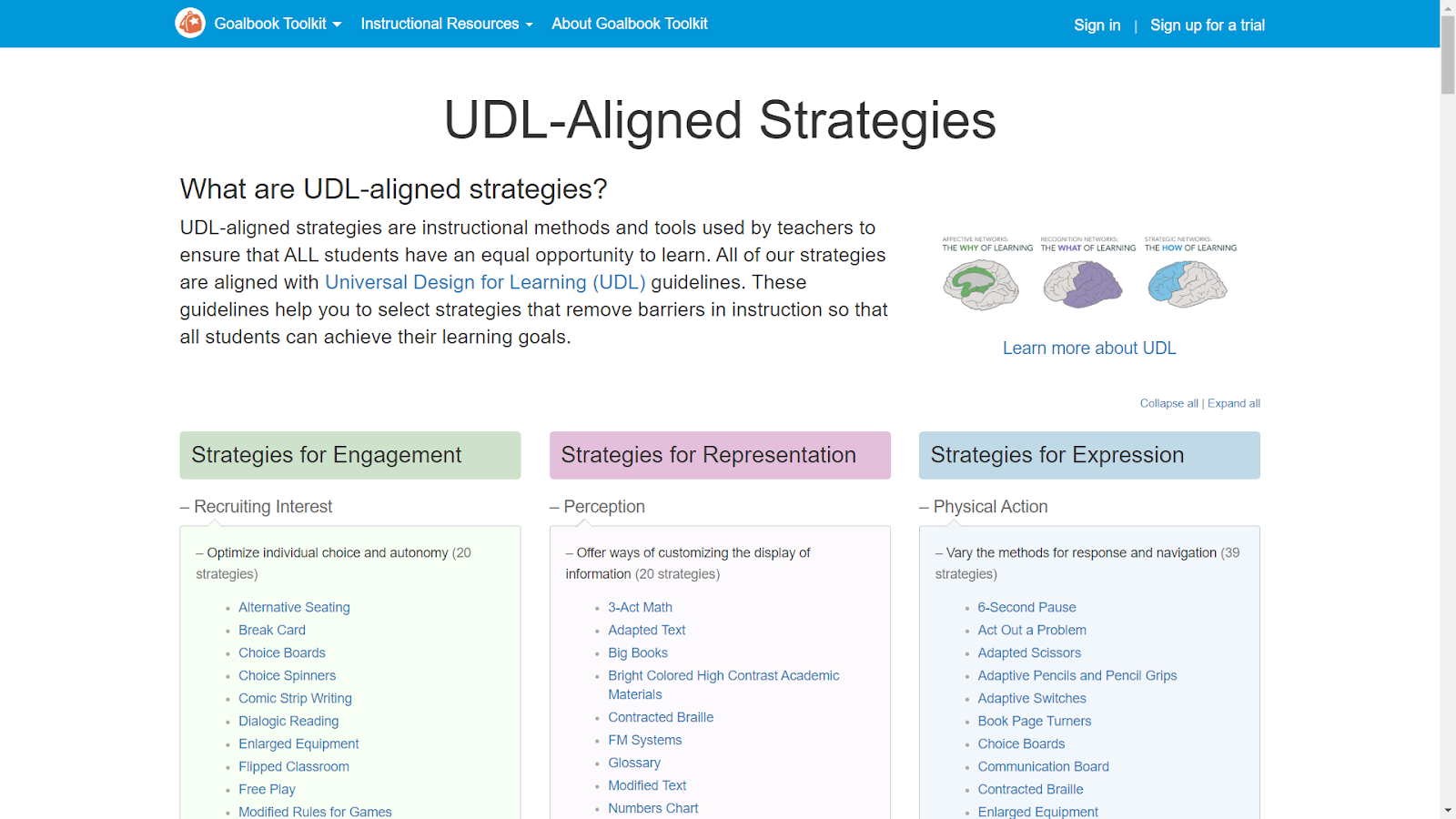
So UDL steps in to provide some much needed strategies. Something which I knew but just needed reminding about. Here’s that awesome GoalBookApp that lists a million strategies for future reference:

I could stop here and that would be that. There’s enough in this website to bolster your teaching strategies for eons. Except, it’s me and I like exploring ideas.
Like one that was thrown out about the idea of being “agentic.” Albert Bandura explains that: “people are producers as well as products of social systems .” That students have differing levels of agency – direct personal agency, proxy and collective.
This aligns strongly with a UDL perspective whereby students learning can be assisted by examining their engagement, ways of representing and then expressing learning.
Overlaid on this of course is the social constructs of the classroom with all of the complexities that this entails.
I threw down “Gardiner” in my notes, although I haven’t heard recently that this old gem has garnered much positive press. I still think it’s gold, in examining my pedagogy because it causes me to think about the different modes that I deliver content, attempting to engage with a wider variety of learners than just the standard visual and textual menu.

I should do this writing thing more. It’s helpful to get the ideas flowing and to reflect on practice. I wonder where I’ll head next.
Reference
Bandura, A. (2001). Social cognitive theory: An agentic perspective. Annual review of psychology, 52(1), 1-26. doi: 10.1146/annurev.psych.52.1.1
Engaging learners with UDL
This brief slideshow was a presentation to staff on engaging learners using UDL strategies.
We collaborated together to investigate different Apps and Strategies – wondering about the following set of questions:
How might we…
- Use these strategies in our class(es)?
- What have you found useful in your class?
- How do we best engage learners using digital technology? Why is this so?
As ever, the very useful Goal Book App of UDL Strategies came to the fore and provides a “go to” reference of excellent strategies for use in the classroom 🙂
Tweet
How to progress learners from Year 10 Social Studies into Level 1 NCEA?
One of the major issues that faces students is the “jump” in the levels of thinking between junior high school in Year 9/10 and senior schooling in NCEA Levels 1-3. Students need help to build “bridges” as they navigate the progression of courses in my area of Geography especially with their conceptual understanding.
This year, my inquiry has focussed on examining trying to help students build better “bridges” in navigating these complexities. One of my findings from previous inquiries has been that students need to reduce the quantity of writing and regurgitation, but increase the quality of their writing with a greater focus on more complex levels of progression.
What do we know about this problem? Data from the Year 10 cohort in 2018 is interesting, and is reproduced below
Scanning
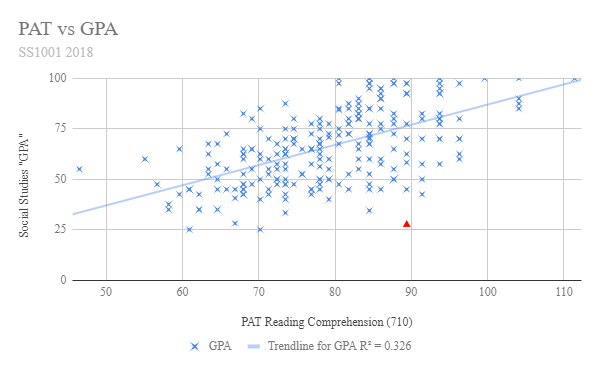
Looking at the gap between our Year 10 SS program and NCEA Level 1 progress, there seems to be a significant gap, especially for our Stanine 3 and 4 learners.
How does this translate to the transition to NCEA Level 1, and what can we learn about about this progress?
Focussing
Sasse and Wood (2017) explore this issue and recommend that rubrics developing values, perspectives and conceptual understandings are the most effective ways of helping to prepare our young people develop what are sometimes termed Higher Order Thinking Skills or HOTS. This concentrates on more critical and complex thinking patterns rather than mere content and regurgitation/ rote memorisation of material learnt in class.
Further work will be completed with Dr Bronwyn Wood from VUW in this regard as we look to ways to increase conceptual progression and further dissect values / perspectives participation in society.
Tables 1 and 2 below illustrate these levels of progression:
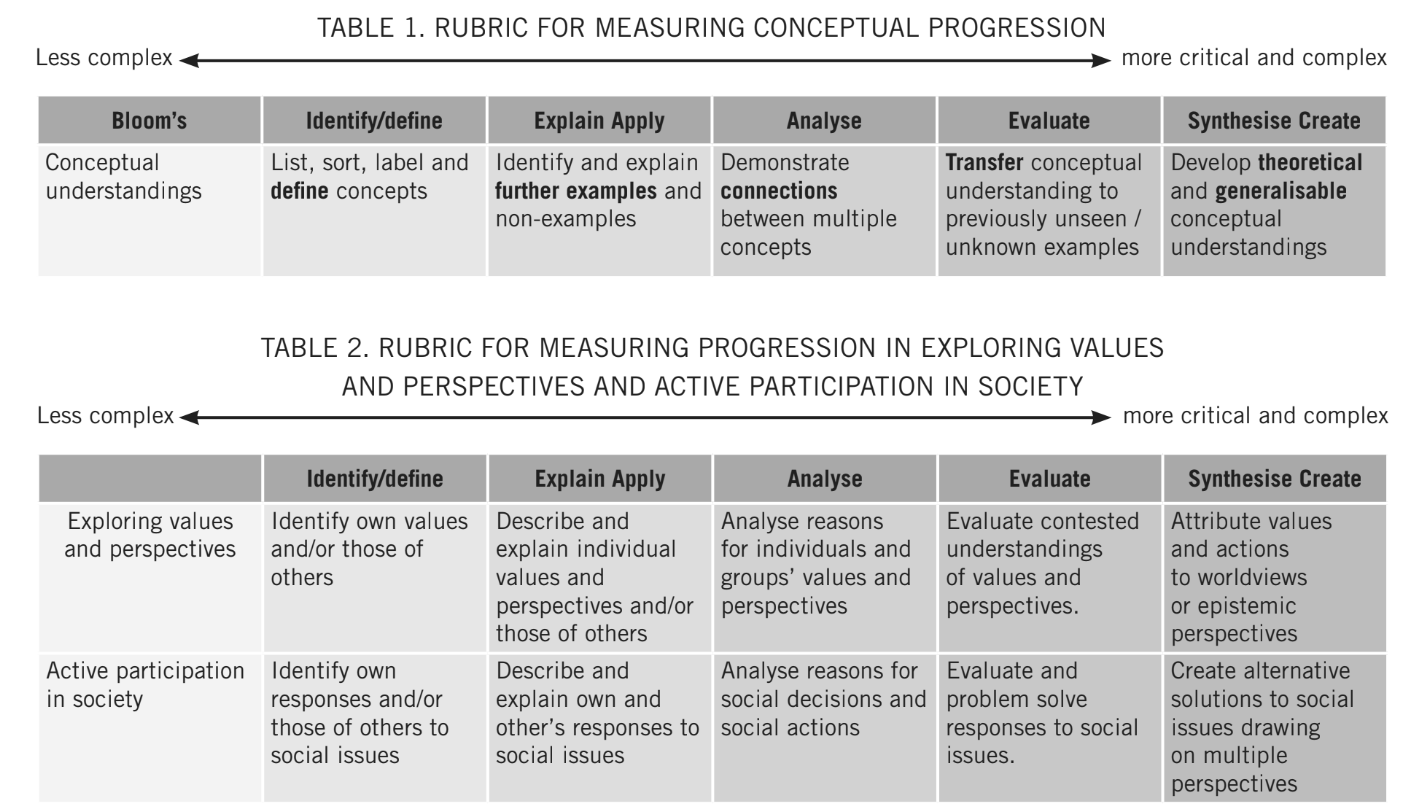
This closely mirrors work already underway in regards to the Junior Assessment Framework and also ties in closely with work on SOLO (Pam Hook and others) around extending abstract thinking etc.
Developing a hunch
| What are our assumptions about what is contributing to the situation? |
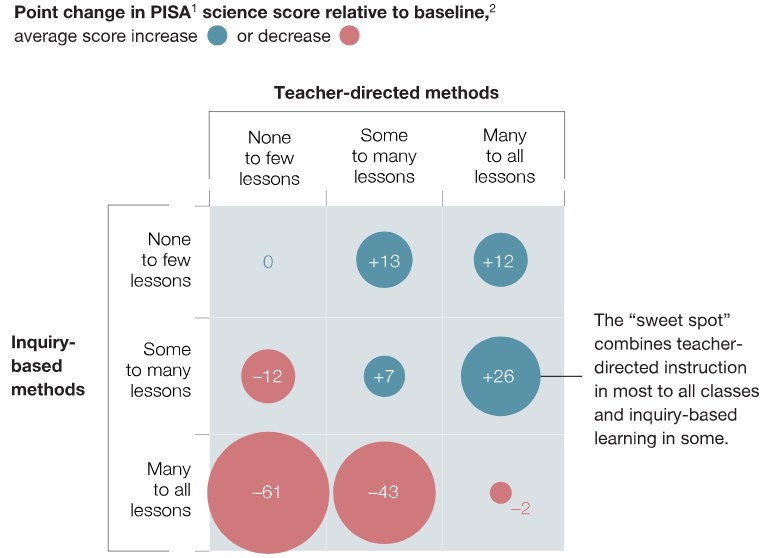
| My own teaching practice: perhaps only reflects less complex exploration of values/ perspectives and participating in society. How can I promote and encourage my own teaching practice to become more critical and complex? How can I promote this in my students learning? This creates questions of around / efficiencies of “delivering” standards using direct teaching methods. This links to a presentation that I heard at the Future of Education conference in Melbourne Australia in 2018. Peter Grattan identified that there is a “sweet-spot” between teacher directed methods and inquiry directed methods. This intuitively makes sense, however there is work (reproduced above) by McInsey & Co. (2018) that provides emerging evidence that “Students who receive a blend of teacher-directed and inquiry-based instruction have the best outcomes.” My assumption here would have previously have been focussed on facilitating good inquiry, this research necessitates a shift towards more teacher directed methods where appropriate. At a junior level, it is difficult sometimes to find the “sweet spot” between high engagement and directing students to Fullan’s “deep learning,” one of the PC way principles.There is a strong preference in my pedagogy to privilege Social Inquiry over Direct Teaching. How can I alter my teaching practice to hit the “sweet spot?” This spot is aiming the teaching and learning at the space where student interest is met by more teacher directed strategies to optimize student learning. This creates the need for students to be able to both take greater agency and control over their learning and the ability for these students to be able to take ownership of their own feedback. Currently, my hunch is that there is a wide variance in the ability of students to assess their own abilities. |
New Learning
The major piece of work from our department this year has been a shift in our assessment practice towards a “generic” assessment criteria sheet (right). What this means is that all of our marks now are comparing “apples with apples” as all assessment fall under the Junior Assessment Framework.
For example, Year 9SS students did an inquiry into Earth Rights in Term 2, and also completed an inquiry in Term 3 that was focussed on Early (pre Treaty) New Zealand. This allows for direct comparison of results. Whereas previously, different mark schedules would mean that these results were not necessarily indicating a progression.
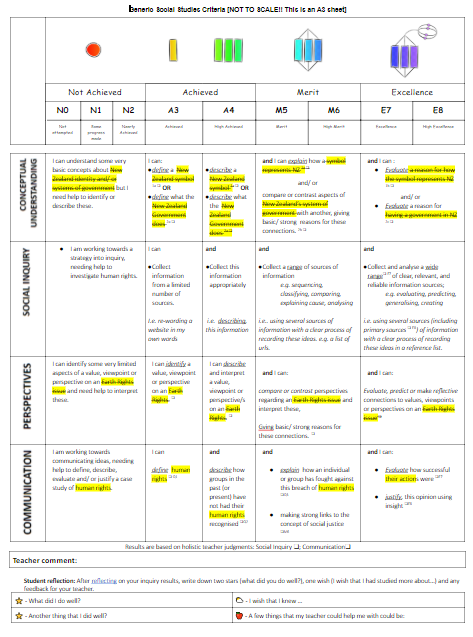
This will have significant implications for our practice here at the College.
Taking Action
Rapid Cycle of Inquiry (RCI) 1 – TLIF: “Self Reflection”
Using Derived Grade Exam results to require students to reflect and target their areas required to optimize their results.
RCI 2 – TLIF: Reflection Tools:
One of the outcomes from the recent TLIF project has been around finding strategies to help students reflect and grow from their reflections.
Some of the evaluation from students on themselves is too harsh – overly hard on their progress, while some are too lenient – over confident in their abilities. It seems that the edges are where expectations around results are where students need to temper their results – mostly through growth mindset strategies. For instance the Excellence student who says: “I’m going to fail this assessment.” versus the Not Yet Achieving student who would say: “Oh yeah, I did alright.” Both require a shift in thinking to become more able to more accurately identify their abilities and next steps.
Checking
Ignoring the outliers and what one colleague terms the “trumpeters,” I think that I’ve done my level best in helping to work with students this year in making a difference at the Year 10 and Year 11 “bridge” in helping students assimilate to the rigours of NCEA Level 1. …
The feedback from Year 11 Geography students on the help provided on this “bridge” can be seen in the student feedback in the course evaluation to the question,
“How did your teacher help you to learn this year?”
Students said:
“With helpful feedback and assistance throughout projects
“He told us about all of the aspects of each assessment that we needed to do so that we didn’t miss anything out.
Students of Year 11 Geography in 2019 Course Evaluation
“A lot of good feedback and one on one conversations in class
“made sure that I understood what I was doing and tried to explain things to me
“he helped a lot by giving me feedback on all my work
“he gave the class resources on PC4Me and he could have maybe done some more one on one or early tutorials for externals.
“By giving detailed and specific feedback to assessments, and how better marks can be attained.. By growing my curiosity with cloud knowledge.
“I liked that he explained everything very clear[ly] (e.g what the exam looked like), he was easy to ask questions to and gave heaps of feedback.
“He provided lots of resources and examples for all the assessments, for achieved, merit and excellence and gave lots of helpful feedback on assessments.
“He explained everything in detail and guided people when they were struggling.
“He made sure not only me but the whole class knew what they were doing and if we needed help that he would help us.
“My teacher helped me learn by providing many different resources so that you could learn in many different ways [such] as audio and visual. He drew diagrams on the board and showed us how to do something before giving us work on that topic. He gave us freedom but structured freedom so that we were focused but it didn’t feel boring. He gave us feedback and many revision resources. He showed us videos and connected all topics to our life outside of school. “
Tweet
And a comment from a Year 13 student, summarizes how this is perceived quite succinctly:
“… the thing I find a shame about [Humanities] is that it’s not widely recognised as a valuable subject or academic subject, because it just shows a different type of intelligence\ skill set to other subjects.”
A Year 13 Social Studies student
“My teacher helped a lot with my learning this year. It was very helpful when he would leave us comments and feedback on our documents so that we knew what we had to change or add to make it better. He also helped by writing lots of important information on the board so that we knew what we had to know.“
Tweet
Tips and tricks for elearning
Tips and tricks to adapt elearning in the classroom
The following resources are designed to help teachers adapt to elearning in the classroom.
Digital Tools

The following pinterest page was setup as a small kete outlining further strategies and tools that teachers may find useful in their classes as they embark on the digital journey –
Personalisation and eLearning Pinterest Page

Personalisation and elearning
This website was developed as a support for staff to navigate personalisation and elearning as part of a year long collaboration through an SCT role at my school (click to follow link):

Although personalisation might sound like a simple concept, finding a single definition is not an easy process. The term is common in an educational setting, however, its usage is complex and varied. The terms active learner, metacognition, self-motivation, collaborative learning, differentiation, choice-based learning, self-regulated learner and individualisation all appear across the literature. Aspects of each of the above have links to personalisation pedagogy, yet a single overlap of ideas is not apparent. Personalised learning can also be defined as helping students discover what makes them want to learn.
For the purposes of this project we considered personalised learning to mean students understanding how they learn, owning and driving their learning, and having a voice in the construction of the curriculum and their learning environment. This also encompasses the need for learning to target student individual strengths, interests and needs. We do not consider personalisation to be viewed as an individualised activity, but a collective one. It is not to be confused with individualised learning where students sit alone in front of a computer.The act of working together can help lead to individual growth in learning.
Why focus on personalisation?
In developing a personalised learning approach using digital technology as a tool, the undertaking of the teacher is to help students master the process of learning (Fullan & Langworthy, 2014). This involves making the learning process visible (Hattie, 2009); integrating learning areas, and allowing students to have a voice in determining their own projects (Rosenstock & Kluver, 2003); connecting to the students interests and aspirations (Fullan & Langworthy, 2014); and evaluating the learning process to ensure that learning is taking place and adapting as necessary.
Personalised learning has also been postulated as a means of putting the child at the centre of the learning by shaping the teaching around the way young people learn (Padget, 2010). This also involves planning for a combination of collaborative opportunities as well as independent learning whilst using the strengths and needs of students to guide decision making. It has been found that when a teacher is willing to incorporate student input into the learning, and to relate the learning experience to the needs of the students, this will be of greater benefit to the student (Burger, 2007). It is important to understand that actions and choices of the teacher remain critical because it is through the teachers’ understanding of learning that opportunities are opened up to which the students can respond.
The type of personalised learning we espouse is based on the strengths and needs of students in a setting which offers choice. Reinforcing the notion that personalisation is not synonymous with individualisation, Johnson (2004) states that within a personalised learning framework, there is greater opportunity for collaboration and connected learning.
Why connect with e-Learning?
Technology is a powerful tool that in the hands of capable teachers can result in significant achievement gains for students, enabling the realisation of the holy grail of education, personalised learning (Domenech, Brown, & Sherman, 2016). Underpinning this is the concept that technology should be considered a tool that can be utilised to achieve teaching and learning goals; this implies that positive outcomes of the use of technology should not be considered guaranteed, but are dependent on varied influencing factors. Many teachers want to embrace technology as an embedded component of a 21st-century classroom, however, the task arises to ensure that the focus is on improving engagement and learning through including students’ strengths and interests, and not simply using digital tools because of their ubiquitous availability. The technology must support the learning, rather than be used as a replacement activity. Instruction should not be driven by the technology; technology should be selected to suit the pedagogical approach and the learning needs.
Some of the readings we considered when devising our project:
Conole, G. (2010). Personalisation through technology-enhanced learning. In G. Conole, & J. O’Donoghue (Ed.), Technology-Supported Environments for Personalized Learning: Methods and Case Studies (pp. 1-15). Hershey, New York: Information Science Reference. doi:10.4018/978-1-60566-884-0.ch001
Crook, C., Harrison, C., Farrington-Flint, L., Tomás, C., & Underwood, J. (2010). The Impact of Technology: Value-added classroom practice. Coventry, UK: Becta.
Fullan, M., & Langworthy, M. (2014). A rich seam; How new pedagogies find deep learning. London: Pearson. Retrieved from http://www.michaelfullan.ca/wp-content/uploads/2014/01/3897.Rich_Seam_web.pdf
Gallagher, R. P. (2014). Implementations of technology enhanced personalized learning: Exploration of success criteria, concerns and characteristics. Malibu: Pepperdine University.
Hargreaves, D. (2004). Personalising learning: Next steps in working laterally. London: International Network for Educational Transformation.
Hargreaves, D. H. (2006). A new shape for schooling? London: Specialist Schools and Academies Trust.
OECD. (2015). Implications of digital technology for education policy and practice. OECD, Students, Computers and Learning: Making the Connection, 185-195. Retrieved from www.oecd-ilibrary.org/docserver/download/9815021ec011.pdf?expires=1448953071&id=id&accname=guest&checksum=96E8356DCF170F0C624D217358B8EE0A
Padget, S. (2010). Personalised learning: A critical guide. United Kingdom.
Pollard, A., & James, M. (Eds.). (2004). Personalised Learning: A commentary by the teaching and learning research programme. Economic and Social Research Council . Retrieved from http://www.tlrp.org/documents/personalised_learning.pdf
Rosenstock, L., & Kluver, J. (2003). Choice and diversity: Irreconcilable differences? Principal Leadership, 3(8), 12-18.
Siemens, G. (2004). Connectivism: A learning theory for the digital age. International Journal of Instructional Theory and Distance Learning, 1-7. Retrieved from http://www.elearnspace.org/Articles/connectivism.htm
Starkey, L. (2012). Teaching and learning in the digital age. Oxon: Routledge.
Starkey, L. (2017). Three dimensions of student-centred education: a framework for policy and practice. Critical Studies in Education, 1-16.
Starkey, L. (2012). Teaching and learning in the digital age. Oxon: Routledge.
Starkey, L. (2017). Three dimensions of student-centred education: a framework for policy and practice. Critical Studies in Education, 1-16. DOI: 10.1080/17508487.2017.1281829
Piquing curiosity 2
How can elearning tools pique curiosity in Social Studies?
The following presentation summarizes my findings into this area in my second of third inquiries as part of a TLIF project:
Tools such as Mouldey’s “catalysts for curiosity” (2014) help:
- WonderWall
- Question Storming – create 50 questions, then rationalise down to best…
- Curiosity Tables
- Open vs Closed Questions
- Question Grids
I would like to focus on the “diversity of teaching strategies” that are mentioned by Hattie’s (2008) research, to create multiple opportunities for students to create and control their learning in a collaborative fashion and so as to allow the maximum opportunity for feedback. Universal Design for Learning will be a helpful guide on this journey:

Some things in life cannot be googled
The following Prezi was my first attempt at trying to summarize 12,000 words and 150 odd references to some colleagues:

This presentation (click on image above to access the Prezi) has now been accepted into a Journal for publication which is very exciting, Here’s a link to the publication – in the Journal for Youth Studies.
Citation
(2019) Some things in life can’t be ‘Googled:’ A narrative synthesis of three key questions in outdoor education., Journal of Youth Studies, 22:3, 312-329, DOI: 10.1080/13676261.2018.1506096


